Orbital Maneuvers in Geostationary Orbit: Enabling Inspection, Servicing, and Space Domain Awareness
An overview of advanced radiation-tolerant compute architectures designed to support autonomous spacecraft operations, onboard processing, and resilient mission execution in demanding space environments.
Understanding Mobility in GEO
Geostationary Earth Orbit (GEO) remains one of the most strategically important regions of space. Located approximately 35,786 kilometers above Earth's equator, GEO hosts critical communications, weather, missile warning, and national security satellites. Unlike Low Earth Orbit, where spacecraft move rapidly relative to the Earth below, satellites in GEO appear fixed over a single longitude, making them ideal for persistent coverage.
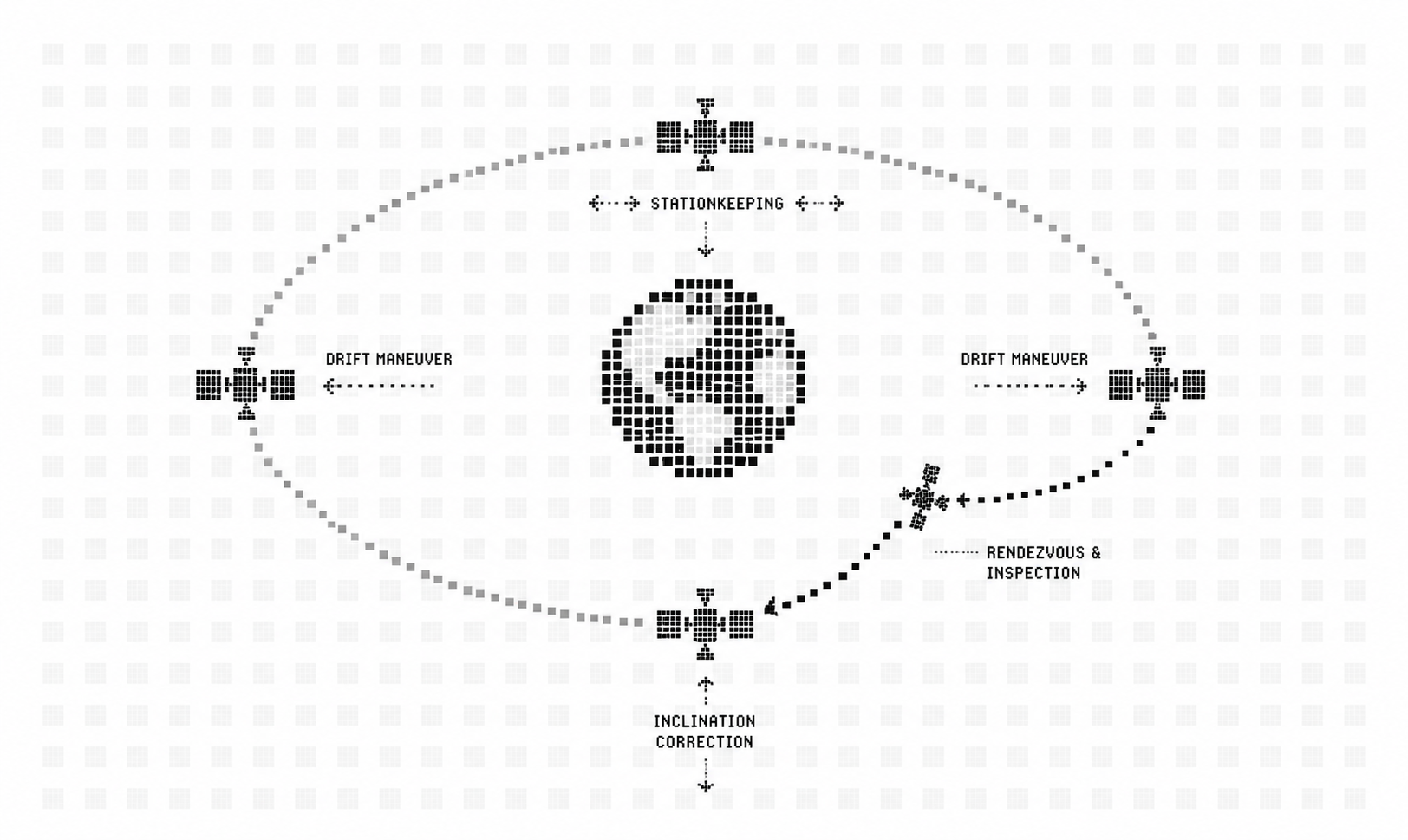
Despite appearing stationary, spacecraft in GEO are constantly executing orbital maneuvers to maintain position, avoid collisions, relocate to new operational slots, or conduct inspection missions. As the number of assets in GEO continues to increase, maneuverability is becoming a key enabler for space domain awareness, servicing, and responsive operations.
Why Spacecraft Maneuver in GEO
Orbital maneuvers serve several important purposes:
- Stationkeeping and orbit maintenance
- Longitude relocation between orbital slots
- Inclination correction
- Rendezvous and proximity operations (RPO)
- Space domain awareness missions
- Inspection of resident space objects
- Collision avoidance
- End-of-life disposal
For many missions, propulsion capability is no longer simply a means of maintaining orbit—it is becoming a mission-critical payload capability.
Stationkeeping Operations
Even though GEO satellites orbit at the same rate as Earth's rotation, natural perturbations continuously disturb their position.
Primary disturbances include:
- Lunar gravitational effects
- Solar gravitational effects
- Solar radiation pressure
- Earth's non-uniform gravity field
To counter these effects, satellites perform periodic stationkeeping maneuvers.
Typical GEO stationkeeping requirements:
- North-South Stationkeeping: ~40–50 m/s per year
- East-West Stationkeeping: ~1–5 m/s per year
For most GEO satellites, north-south stationkeeping dominates propellant consumption over the mission lifetime.
Longitude Relocation Maneuvers
Operators frequently relocate spacecraft to new orbital slots to support changing mission requirements.
These maneuvers are typically performed by slightly raising or lowering the spacecraft's orbit to induce drift.
A spacecraft moved into a higher orbit drifts west.
A spacecraft moved into a lower orbit drifts east.
Once the desired longitude is reached, a second maneuver circularizes the orbit back to GEO.
Benefits include:
- Repositioning communications assets
- Replacing failed spacecraft
- Supporting surge capacity
- Enabling regional mission coverage
Relocation maneuvers typically require only a few meters per second of delta-v but may take days or weeks depending on desired drift rate.
Inclination Changes
Inclination changes in GEO are among the most expensive maneuvers from a propellant standpoint.
Because orbital velocity in GEO remains approximately 3.07 km/s, even small plane changes require significant delta-v.
For this reason:
- Active GEO satellites perform regular inclination maintenance.
- Aging satellites often discontinue inclination control to conserve propellant.
- End-of-life spacecraft are frequently allowed to drift into inclined GEO orbits.
These inclined-orbit satellites can create unique opportunities for observation and inspection missions.
Rendezvous and Proximity Operations
One of the fastest-growing mission areas in GEO involves Rendezvous and Proximity Operations (RPO).
These missions enable spacecraft to:
- Inspect satellites
- Characterize anomalies
- Monitor foreign space assets
- Support servicing missions
- Gather intelligence
- Verify spacecraft status
Unlike traditional stationkeeping operations, RPO requires carefully planned relative motion trajectories that minimize fuel consumption while maintaining safe separation distances.
Common GEO inspection distances include:
- 50 km standoff observation
- 10 km characterization
- 1 km close inspection
- Sub-100 meter servicing operations
The closer a vehicle approaches a target, the greater the navigation, sensing, and autonomy requirements become.
Drift and Natural Motion Circumnavigation
One technique commonly used in GEO inspection missions is Natural Motion Circumnavigation (NMC).
NMC trajectories allow an inspector spacecraft to naturally orbit around a target using orbital dynamics rather than continuous propulsion.
Advantages include:
- Reduced propellant consumption
- Continuous target observation
- Passive safety characteristics
- Long-duration monitoring opportunities
These trajectories are particularly attractive for persistent space domain awareness operations.
Fuel as a Strategic Resource
In GEO, propellant is often the primary life-limiting resource.
Every maneuver must be carefully evaluated against mission objectives and remaining lifetime.
Modern spacecraft increasingly incorporate:
- Efficient propulsion systems
- Autonomous maneuver planning
- Onboard orbit determination
- Predictive fuel management
- Autonomous collision avoidance
These capabilities allow spacecraft to maximize mission effectiveness while extending operational life.
The Future of GEO Maneuvering
Historically, GEO satellites were designed to remain largely fixed throughout their operational lives. That paradigm is changing.
Emerging missions demand spacecraft capable of:
- Dynamic repositioning
- Persistent inspection
- Autonomous operations
- Cooperative servicing
- Responsive space domain awareness
As maneuverability becomes a defining mission capability, future GEO spacecraft will increasingly combine advanced propulsion, onboard autonomy, precision navigation, and sophisticated sensing systems to operate effectively in a more active and contested orbital environment.
Conclusion
Orbital maneuvers are fundamental to nearly every GEO mission. From routine stationkeeping to advanced rendezvous and proximity operations, mobility enables spacecraft to maintain mission effectiveness, extend operational life, and support emerging space domain awareness and servicing missions.
As activity in GEO continues to grow, the ability to maneuver efficiently, safely, and autonomously will become one of the most important capabilities for future spacecraft operating in this critical region of space.

Haytham Elmasri
Exploring scalable onboard compute technologies enabling next-generation autonomous space missions.