The Future of GEO Operations Requires Small, Agile Spacecraft
Small, maneuverable spacecraft are becoming essential for inspection missions, space domain awareness, and responsive operations in an increasingly active GEO environment.
Geostationary orbit (GEO) has been dominated by large, expensive spacecraft designed primarily for communications, weather monitoring, missile warning, and strategic national security missions. These platforms were optimized for long operational lifetimes and minimal movement, often spending years occupying the same orbital slot while providing uninterrupted service.
The GEO environment is changing. As the number of active satellites continues to increase and space becomes more dynamic, mission success is no longer defined solely by payload performance. Mobility, responsiveness, and the ability to rapidly reposition within the GEO belt are becoming increasingly important capabilities. Traditional GEO spacecraft were never designed for this operating model. While highly capable, they are often optimized for stationkeeping and long-duration operations rather than frequent maneuvering. Emerging missions require a different approach—one centered on agility, flexibility, and responsiveness.
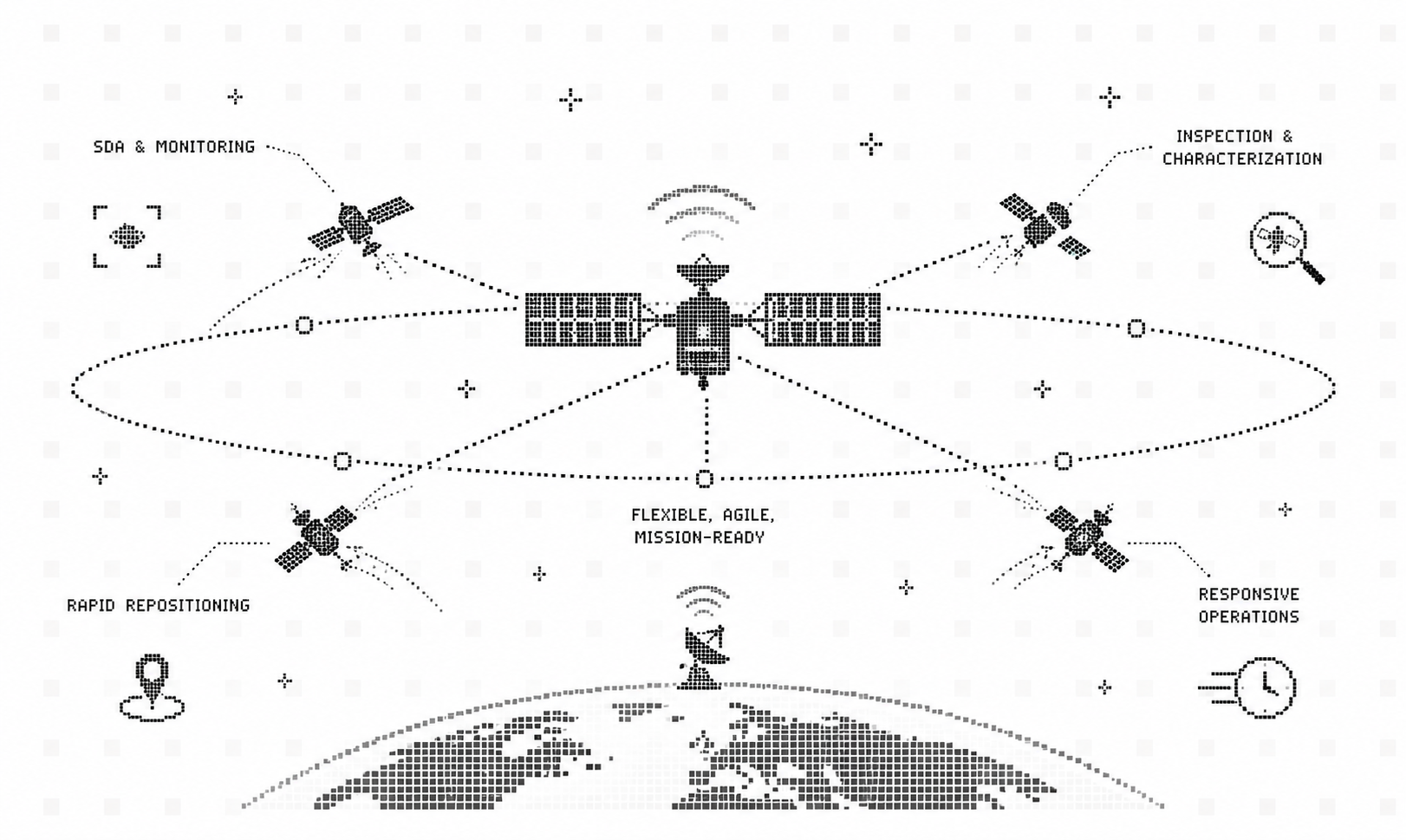
Historically, GEO satellites were expected to remain largely stationary throughout their operational life. Operators focused on maintaining orbital position, ensuring payload performance, and maximizing mission lifetime. Today, operators are increasingly interested in missions that require spacecraft to move. Space domain awareness missions require observing and characterizing resident space objects. Inspection missions require spacecraft to approach and monitor satellites of interest. Responsive operations may require repositioning assets to support emerging mission needs. Future servicing missions may require repeated rendezvous and proximity operations throughout a spacecraft's operational life.
These activities place new demands on spacecraft design and challenge traditional assumptions about how GEO systems should operate. Using a large strategic GEO asset for routine inspection or monitoring activities is often impractical. These spacecraft are optimized for their primary mission and carry significant cost and operational value. Frequent maneuvering can consume valuable propellant and potentially reduce operational lifetime.
Small, maneuverable spacecraft provide a compelling alternative. Rather than dedicating a multi-billion-dollar asset to inspection or characterization missions, operators can deploy smaller vehicles specifically optimized for mobility. These spacecraft can reposition quickly, observe objects from multiple viewing angles, support anomaly investigations, and perform routine monitoring tasks without impacting primary mission systems. This approach allows operators to separate mission functions while increasing operational flexibility across the GEO domain.
Understanding activity in GEO requires more than simply observing satellites from a fixed location. Many objects of interest require repeated observations from different viewing geometries. Changes in illumination conditions, orientation, and relative position can significantly impact what information can be collected. A maneuverable spacecraft can relocate, adjust observation geometry, and collect data that would be impossible to obtain from a static platform. As activity within GEO continues to increase, persistent observation and characterization will become increasingly important. Mobility transforms spacecraft from passive observers into active participants capable of gathering more useful information and responding to changing mission priorities.
One of the most promising applications for agile spacecraft is inspection. When spacecraft anomalies occur, operators often have limited information available to determine root cause. An inspection vehicle capable of approaching a target and collecting high-resolution observations can significantly improve situational awareness and support decision-making. Similarly, rendezvous and proximity operations are expected to play an increasingly important role in future servicing, logistics, and mission support architectures. These missions require spacecraft specifically designed for maneuverability, navigation, and precise control.
Enabling this new class of spacecraft requires more than efficient propulsion systems. Frequent maneuvering, onboard decision-making, advanced sensing, and responsive mission operations place increasing demands on spacecraft avionics and power architectures. The vehicle must be capable of processing large volumes of sensor data, managing complex operational scenarios, and supporting multiple mission functions while maintaining reliability over many years in the GEO environment.
At Nova Solvers, we are developing modular spacecraft avionics and power distribution systems specifically designed to support these demanding missions. Our architecture combines radiation-tolerant computing, scalable power management, deterministic control systems, and flexible payload interfaces that enable spacecraft to adapt to evolving mission requirements. By providing the onboard processing capability required for autonomous operations and the power infrastructure needed to support advanced sensors and maneuvering systems, these technologies help enable a new class of agile spacecraft optimized for inspection, space domain awareness, rendezvous and proximity operations, and other maneuver-intensive missions.
As GEO operations become increasingly dynamic, spacecraft will require architectures that balance performance, resilience, and flexibility. The ability to rapidly integrate new payloads, support autonomous mission execution, and efficiently manage onboard resources will be just as important as propulsion capability itself.
The GEO environment is evolving from a collection of largely stationary spacecraft into a more active and operationally dynamic domain. Supporting this transition requires spacecraft designed not only for performance, but also for mobility. Small, agile spacecraft provide a practical and cost-effective way to enhance space domain awareness, support inspection missions, improve resilience, and enable new operational concepts that will define the next generation of GEO operations. The future of GEO will not be defined solely by larger spacecraft with increasingly sophisticated payloads. It will be shaped by a combination of capable mission platforms and highly maneuverable supporting vehicles working together to provide flexibility, responsiveness, and resilience across one of the most important regions of space.

Haytham Elmasri
Small, maneuverable spacecraft are becoming essential for inspection missions, space domain awareness, and responsive operations in an increasingly active GEO environment.